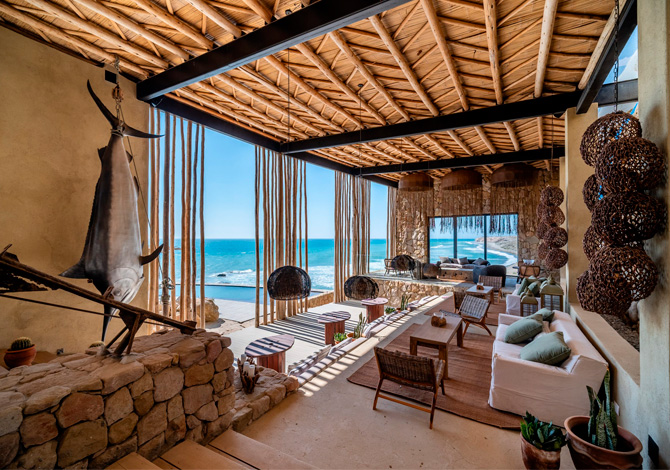
As Inkaterra marks its 50th anniversary, we are celebrating the opening of Inkaterra Cabo Blanco, our eighth property and first-ever hotel on Peru’s Pacific
coast, in one of South America’s most legendary locations. In the 1950s, Cabo Blanco became world-renowned for its record-breaking sport fishing, including the
historic 1,560-pound/707-kilo black marlin (Istiompax indica) landed in August 1953, as well as for Nobel Prize–winning author Ernest Hemingway, who was
drawn to these extraordinary waters in April 1956.
The opening has garnered significant international attention.
Vogue
included Inkaterra Cabo Blanco among sixteen international luxury hotels set to open in 2026, highlighting its location “in a former fishing village in
northwestern Peru” and its proposal for nature-sensitive tourism. The publication emphasizes how the project blends coastal landscapes, cultural storytelling, and
conscious hospitality, appealing to travelers seeking less obvious destinations rich in history.
Vogue
also notes experiences linked to the legendary Miss Texas yacht, used when filming the adaptation of Hemingway’s
The Old Man and the Sea.
Robb Report
likewise named Inkaterra Cabo Blanco among the most anticipated luxury hotel openings of 2026, noting that Inkaterra “has been earning plaudits for its
resource-aware luxury lodges in Peru for more than 50 years.” The publication underscores the brand’s expansion beyond its iconic destinations—such as Machu
Picchu and Cusco—to the northern coastline of Cabo Blanco, long associated with world records for giant marlin fishing that remain unbroken to this day.
From Europe,
Le Figaro
portrays Inkaterra as a pioneer of sustainable hospitality in Peru, renowned for its properties in Machu Picchu and the Sacred Valley, and highlights its arrival
in “one of South America’s most famous fishing sites,” closely associated with Hemingway. The newspaper emphasizes the site’s pristine natural setting and the
hotel’s offering of a coastal retreat immersed in nature, ideal after Peru’s classic cultural itineraries.
Beyond the hotel itself, Inkaterra is advancing a comprehensive vision for Cabo Blanco that extends well beyond hospitality, aiming to restore the marine-coastal
landscape of northern Peru. The initiative integrates science, culture, and tourism, and reestablish Cabo Blanco as an ecotourism development hub for the region,
as well as a model for conservation in the Tropical Pacific. Inkaterra Cabo Blanco is based on four key pillars: high-quality ecological infrastructure; research
and conservation initiatives led by Inkaterra Asociación; ecotourism experiences with strong local identity; and sustainable development strategies to support the
resilience of coastal communities.
The project actively supports the artisanal fishing community, which was declared National Cultural Heritage of Peru in 2018 following an initiative led by
Inkaterra Asociación. In addition, Inkaterra has restored the iconic Miss Texas yacht as a symbol of ocean recovery and a renewed relationship between culture,
conservation, and tourism.
With Inkaterra Cabo Blanco, history meets the future—reviving a legendary destination as a model for ecotourism, conservation, and community-centered development
in the Tropical Pacific.