This month marks 70 years since Ernest Hemingway
visited to Cabo Blanco, a defining moment that
positioned Peru’s northern coast as a place of
global imagination—where literature, navigation,
and marine abundance converge.
In April 1956, shortly after his masterpiece
The Old Man and the Sea was published,
and his receiving the Nobel Prize in Literature,
Hemingway arrived in Cabo Blanco accompanied by
his wife Mary Welsh. He stayed more than a month
at the exclusive Cabo Blanco Fishing Club, where
he oversaw the film adaptation of his novel
while immersing himself in a landscape defined
by ocean, desert, and wind. During his stay, he
fished the Tropical Pacific’s rich waters,
developed a notable skill with the rod, and
engaged closely with the local fishing
community—capturing the essence of a place that
would later be elevated to literary and
geographic myth.
As highlighted in an article by Inkaterra
founder José Koechlin featured in Cosas
Magazine, Cabo Blanco constitutes a site of
exceptional geographical and cultural
convergence. In the 1950s, it rose to prominence
as the “Mecca of big-game fishing,” home to
enduring world records such as the 1,560-pound
black marlin caught by Alfred Glassell Jr. in
1953—still recognized by the International Game
Fish Association—and the 435-pound bigeye tuna
recorded in 1957. These feats, widely
publicized, attracted Hollywood figures,
anglers, and adventurers, consolidating Cabo
Blanco’s identity as a destination of
exclusivity and exploration.
Beyond its fishing legacy, Cabo Blanco has long
been an epicenter for ocean-based experiences.
Its coastline is home to world-class surf
breaks—famously known as “the perfect wave”—and
its waters host the Pacific’s “Blue Five”:
humpback whales, manta rays, orcas, dolphins,
and sea turtles.
Seventy years after Hemingway’s visit, Cabo
Blanco stands at the threshold of a spectacular
renaissance. As noted in Cosas, the
destination is being revitalized under
Inkaterra’s vision, reconnecting its historic
legacy with a forward-looking model of
sustainable development.
Located within one of the most biodiverse marine
corridors in Peru—harboring nearly 70% of the
country’s marine biodiversity—Cabo Blanco is
being reactivated by Inkaterra through
initiatives that span conservation, research,
and local development. Inkaterra Asociación
manages a 104-hectare private marine reserve,
supporting biodiversity protection, sustainable
aquaculture, and traditional sailing fishing
practices, including pearl oyster cultivation
linked to women-led community initiatives.
On land, efforts focus on restoring the tropical
dry forest—one of Peru’s most fragile
ecosystems—through native reforestation
supported by water treatment and
phytodepuration. . The project also includes the
renewal of Cabo Blanco’s historic boardwalk,
using natural bamboo to recover the spirit of
its golden era.
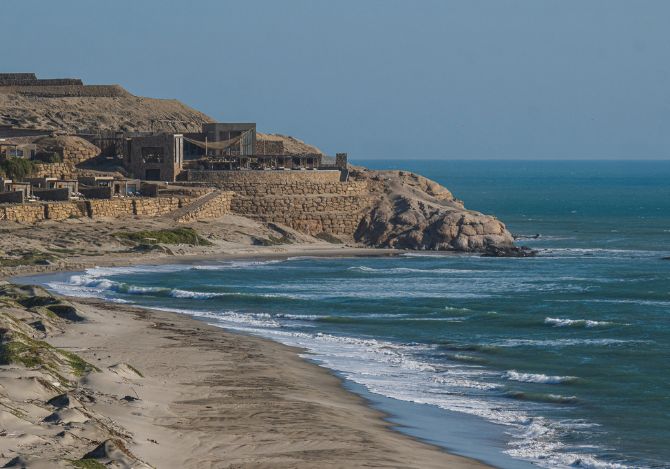
The architectural design pays tribute to Denise
Guislain Koechlin, blending Mediterranean
influences with ancestral Mochica principles of
light and wind. Built with natural materials
such as stone, wood, and bamboo, the project
establishes a refined dialogue with the desert
dunes and the Pacific horizon.
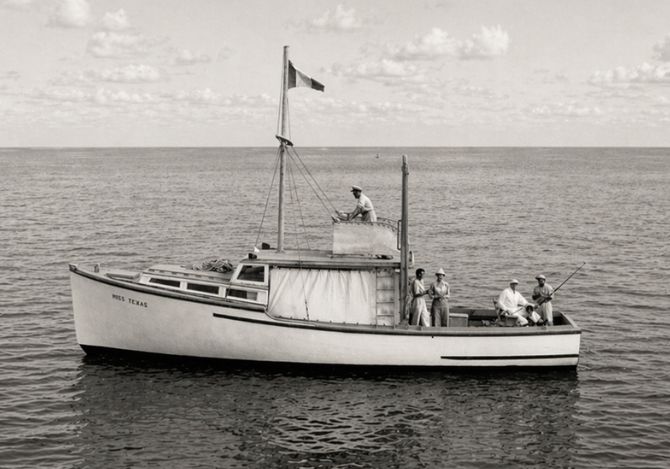
Experiences at the destination reconnect
visitors with its legacy: sailing aboard the
restored Miss Texas (Alfred Glassell and
Hemingway’s iconic fishing boat), artisanal
fishing with local communities, and immersive
encounters with marine life. Inkaterra Cabo
Blanco also emerges as a holistic wellness
retreat, offering therapies such as
thalassotherapy, inspired by the healing
properties of the ocean.
Seventy years after Hemingway’s journey, Cabo
Blanco is reborn—not only as a destination of
legend, but as a living laboratory of
conservation and hope, where history, science,
and community converge to shape the future of
regenerative tourism in Peru’s northern coast.
Reflecting on this milestone, José Koechlin
notes: “Perhaps Ernest Hemingway would recognize
something familiar in this horizon—the open sea,
the wind against the sails, and the enduring
promise of discovery that defines Cabo Blanco.”